
California COVID-19 Virtual Training Academy
A statewide initiative to rapidly scale-up trainings for contact tracers, outbreak investigators, and disease interventions specialists during a public health emergency, 2020–2023.
Context
In March 2020, the Governor of California set an urgent goal: train 10,000 COVID-19 contact tracers by mid-summer. The state had limited training infrastructure, no precedent for this scale and a primary audience of census workers, librarians and other redirected civil servants with little public health experienced tapped to do the work. In-person training was impossible. Everything had to be built from scratch, fast and at scale.
My Role
I worked as Learning Design Lead for the California Virtual Training Academy (VTA+), a partnership between UCSF, UCLA, and the California Department of Public Health. Working alongside world-class infectious disease researchers, epidemiologists, and community partners from the three institutions, my job was to translate their expertise into training that was practical, learner-centered and deployable at scale.
I owned content design and review workflows across a cross-functional team of 150 staff, setting the instructional design standards, and production workflows that governed how content was built and deployed across approximately 30 courses. This was an exceptionally collaborative effort — every work-stream was led and executed by talented colleagues. My contribution was building the design infrastructure and processes that made all of it coherent and consistent.
The Work
Each course was built as a blended model: asynchronous self-study to build knowledge, followed by live virtual sessions where learners practiced through structured role-play and facilitated debrief. The flagship contact tracing course combined 7 hours of asynchronous content with 13 hours of live skill practice across four days.
To make quality repeatable across 150 staff and - by the end of the project - 30 courses, I built the design infrastructure: WCAG-compliant style guides, branded templates, standardized facilitator guides, and content writing, media development and review workflows grounded in Gagné's conditions of learning and cognitive load theory. The artifacts below show that system in practice — from the standards documents that governed every module, to the course design blueprint, to the self-study and live training materials where self-study theory was put into practice.
Work Samples
Self-Study Modules
The self-study components of the blended trainings were built in Articulate Rise to WCAG 2.1 AA standards. Self-guided modules take learners from foundational epidemiological concepts of COVID-19 through the practice of case investigation and contact tracing interviews, with cultural humility and health coaching woven throughout. Interaction types include branching scenarios, role-play videos, practice scripts, labeled graphics, and knowledge checks. Self-study modules in the VTA catalogue were built to a common design standard that I developed and iterated frequently for the program. Here are a few samples.
Course Design Documents and Syllabus
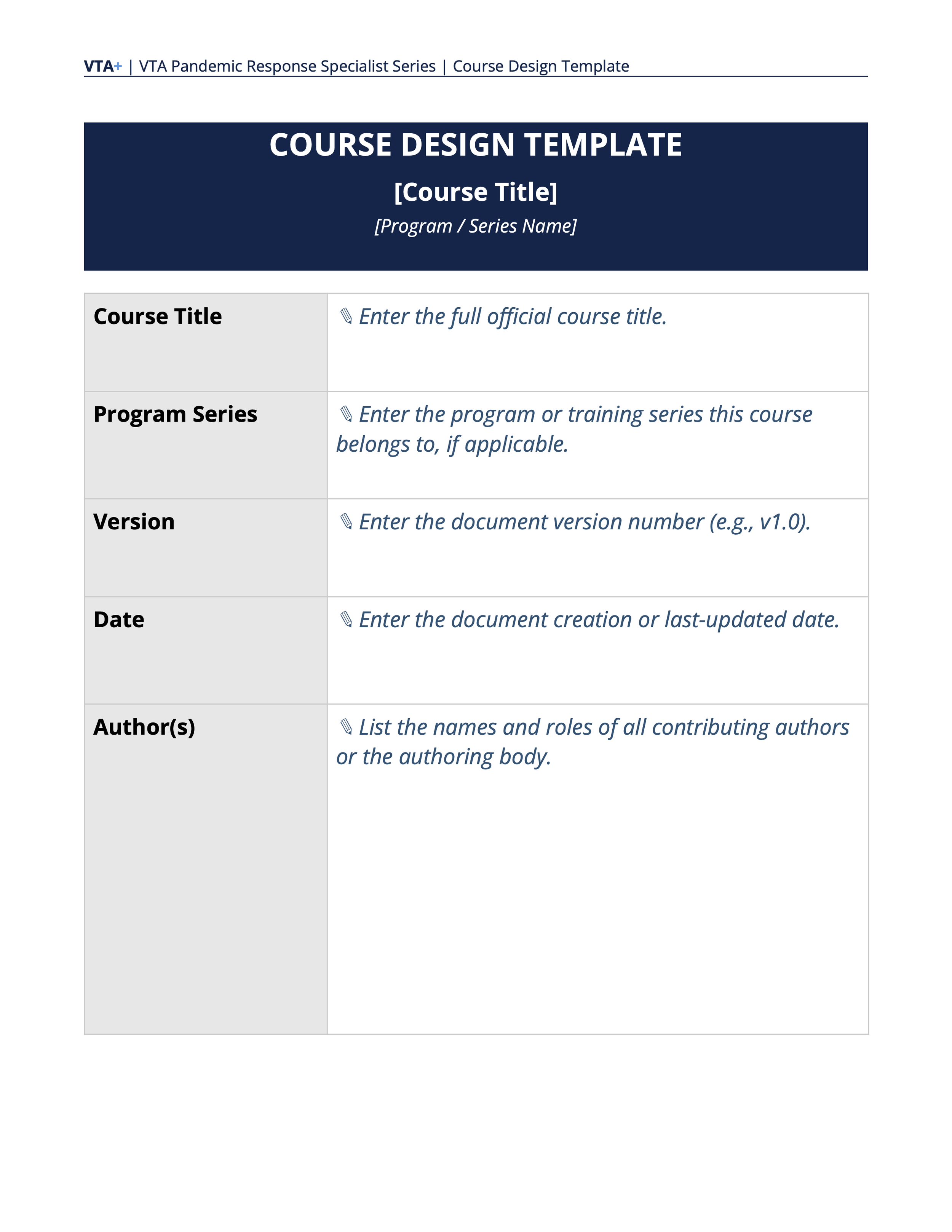
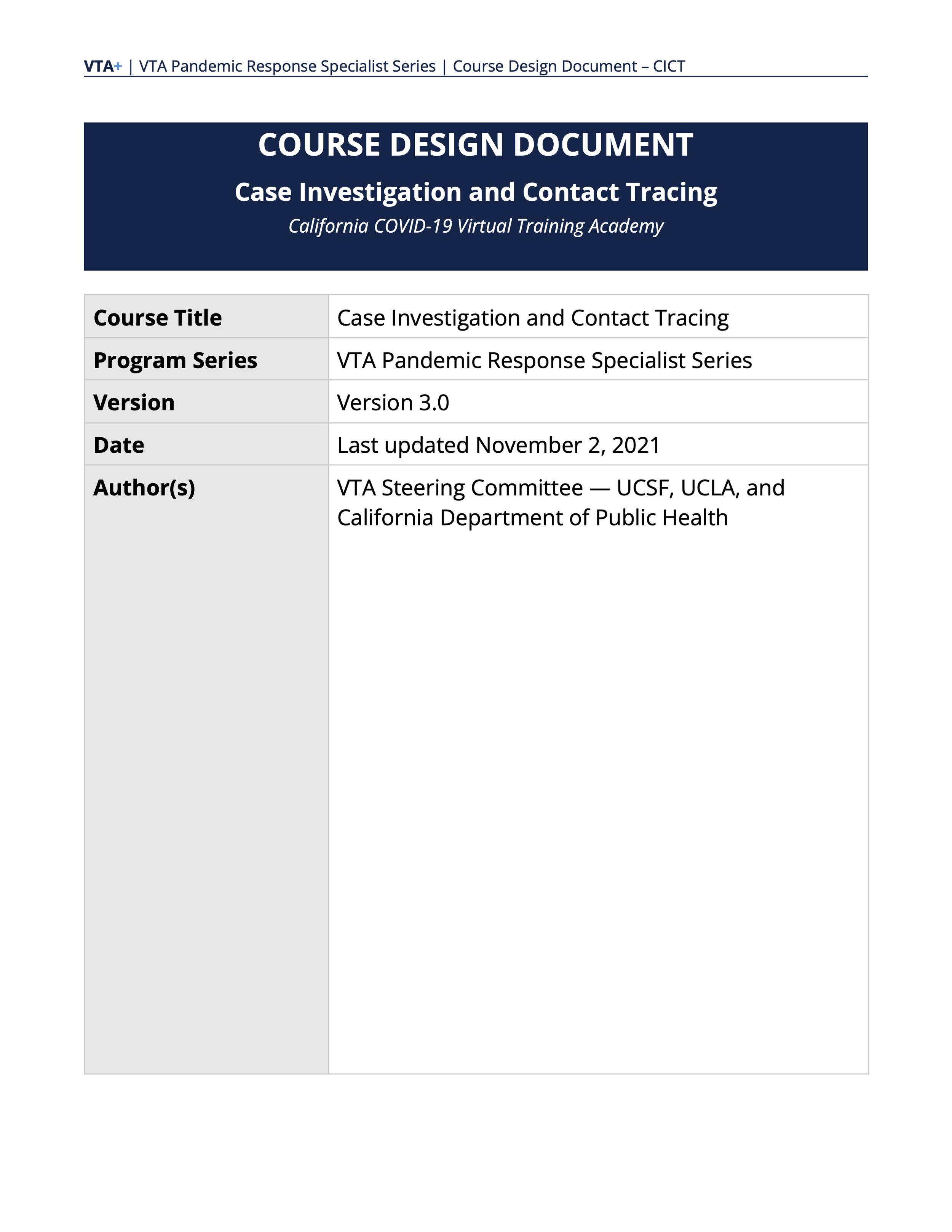
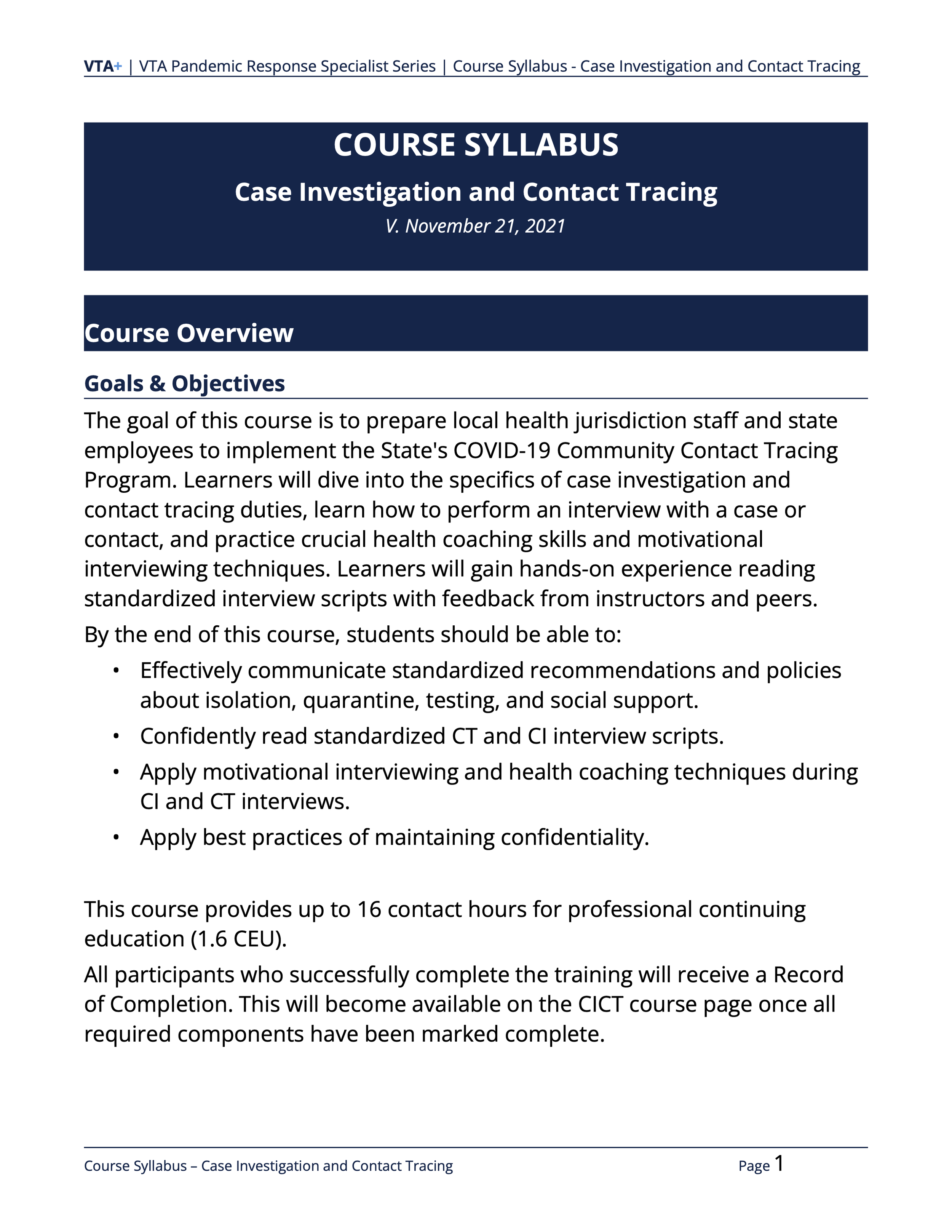
The design document maps each of the self-study modules and live skill lab sessions to learning objectives, time allocations, and SME owners. These are the curriculum blueprints that kept content consistent across 50 courses, 59 cohorts and three years. The syllabus shows how the same structure was communicated to learners, including a pre/post knowledge assessment framework with an 80% mastery threshold required before accessing live training. Read together, they show both the instructional logic and the infrastructure behind it. Links to the full documents are embedded in the screenshots.
Instructional Design Workflows
These diagrams document the instructional design and content production process for designing, assessing and iterating VTA courses. The set moves from strategic to operational: a high-level lifecycle overview for leadership is followed by three internal-facing diagrams covering role and handoff structure, the weekly delivery cycle, and content change triage and approval. Together they serve as both a retrospective record of a rapidly scaled public health training program and a reusable process framework for future virtual training initiatives.
Instructional Design Workflow by Task Force
California COVID-19 Virtual Training Academy — ADDIE framework
| Task Force | Analyze | Design | Develop | Implement | Evaluate | Iterate |
|---|---|---|---|---|---|---|
| STEERING COMMITTEE |
Identify workforce gaps and training priorities statewide | Approve course goals, learning objectives, and module structure | Oversee content development and platform readiness | Monitor statewide rollout and learner enrollment | Review evaluation findings and program performance data | Approve major curriculum revisions and program expansions |
| CURRICULUM TASK FORCE |
Audit existing resources and define learner profile | Write learning objectives across 9 modules. Select instructional strategies. Determine synchronous and asynchronous content split | Develop webinar content, skill lab scripts, and self-study materials. Commission SME review | Update module content weekly in response to CDC and CDPH guideline changes | Review knowledge check scores and learner feedback by module | Revise content, expand cultural humility module, add Spanish-language materials |
| REGISTRATION TASK FORCE |
— | — | Configure registration portal. Define eligibility criteria and verification workflow | Verify learner eligibility. Manage weekly enrollment. Issue completion records to learners scoring ≥70% | Report weekly enrollment, completion, and demographic data to VTA staff | — |
| FACILITATOR TASK FORCE |
— | — | Recruit and train 104 facilitators. Establish shadow onboarding protocol and bi-weekly check-in cadence | Lead weekly skill development labs. Facilitate small-group role-play and deliver individualised feedback | Report learner performance observations and skill gaps to M&E Task Force | Expand facilitator pool. Launch Spanish-language skill labs and optional practice sessions |
| PRODUCTION TASK FORCE |
Evaluate LMS and webinar platforms. Map technical requirements for delivery at scale | Design skill lab delivery structure. Configure Canvas LMS architecture and Zoom session framework | Upload and sequence all content on Canvas. Hire and train production staff. Conduct technical rehearsal | Manage live webinar and skill lab delivery each week. Provide real-time technical support | — | Deploy updated materials to Canvas as course content evolves |
| MONITORING & EVALUATION TF |
Survey 61 local health jurisdictions. Identify training needs and workforce gaps | Align assessment instruments to learning objectives. Design pre and post knowledge checks and satisfaction surveys | Load assessments into Canvas. Run pilot with 31 learners. Report findings to Curriculum Task Force | Administer assessments each cohort. Conduct key informant interviews with program completers | Analyse knowledge scores, satisfaction data, and qualitative findings. Distribute weekly cohort report | Identify revision priorities. Track quality measures across successive cohorts |
Design & Develop — Content Architecture and Media Production Workflow
California COVID-19 Virtual Training Academy — detailed instructional design and production process
Design phase
Learning objectives mapped to content type, delivery modality, and instructional purpose. Each decision reflects a deliberate strategy: knowledge transfer delivered asynchronously; skills practice delivered synchronously with facilitator feedback.
CONTENT TYPE
MAPPING
Foundational content: COVID-19 epidemiology, CI/CT overview, containment strategies, isolation and quarantine guidelines
Asynchronous self-study Live webinarInterview techniques, script delivery, agenda-setting, active listening, health coaching tools: Ask-Tell-Ask, Closing the Loop, Action Planning
Synchronous skill labsCultural humility, implicit bias, social determinants of health, empathy and rapport-building with communities most affected by COVID-19
Live webinar Embedded in skill labsReference tools for use during active CI/CT work: interview scripts, quarantine calculation guides, referral pathways, platform navigation
Job aids (LMS)for the next level of practice
Workflow
Develop phase
Six parallel production tracks managed simultaneously. Each track moves from content outline through script and draft to review, approval, and LMS deployment. Curriculum Task Force owns content; Production Task Force owns build and delivery.
PRODUCTION
TRACKS
PRESENTATIONS
VIDEOS
SCRIPTS
GUIDES
GUIDES
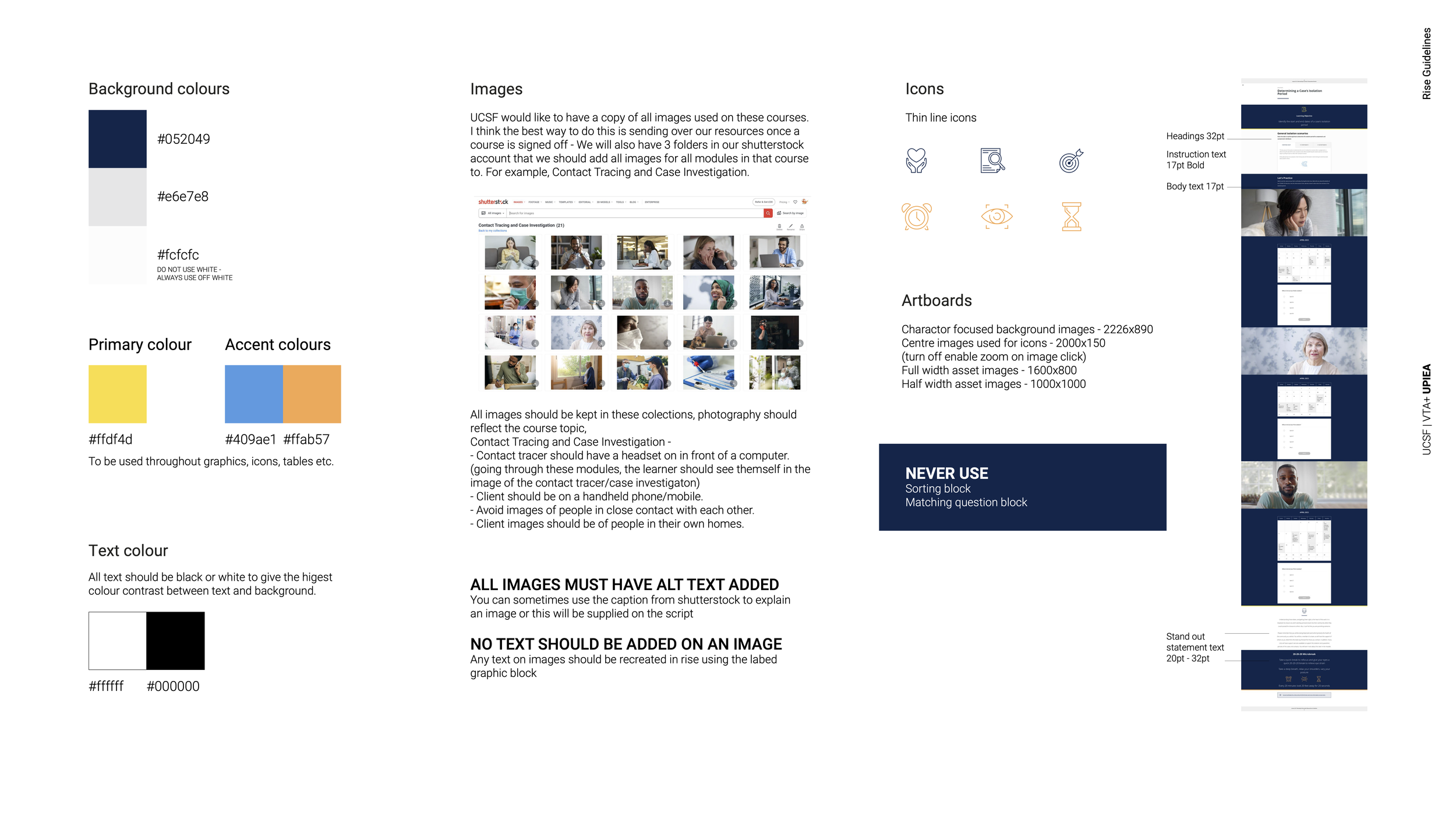
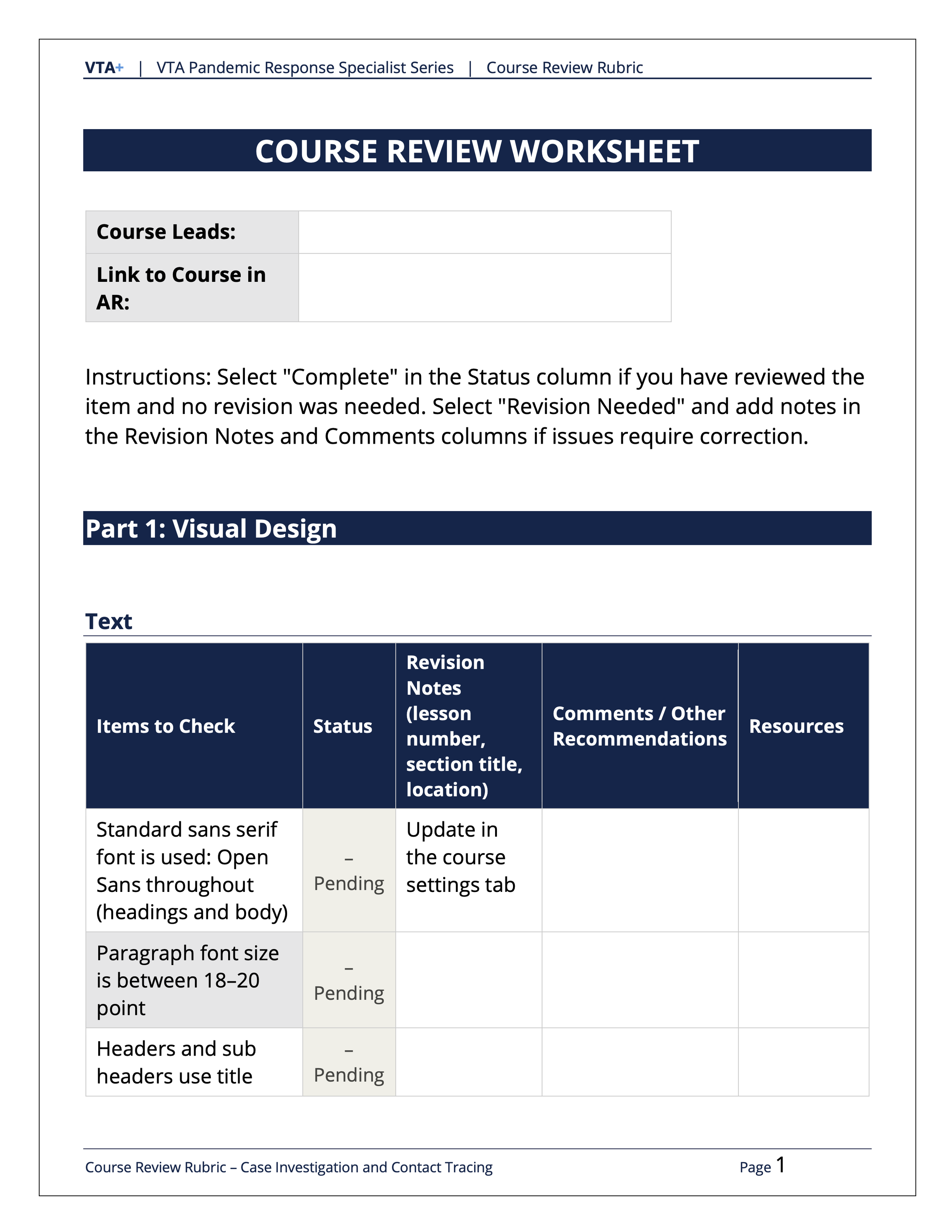
Style Guide + Course Review Rubric
Style guide — The visual and production standards governing self-study modules across the VTA+ catalog. Covers color palette, typography, image specifications, accessibility requirements, and block usage rules. The reference document kept 150 dispersed staff building consistent, WCAG-compliant content across 30 courses and three years.
Course Review Rubric — The two-part quality assurance framework used to review every module before release. The first sheet covers visual and technical production standards. The second covers instructional design quality: whether objectives describe observable behaviors, whether activities reflect on-the-job decision-making, whether assessments go beyond recall. Built on Gagné's conditions of learning and cognitive load theory. This is the mechanism that turned design standards into a repeatable quality process.
Live Training Materials
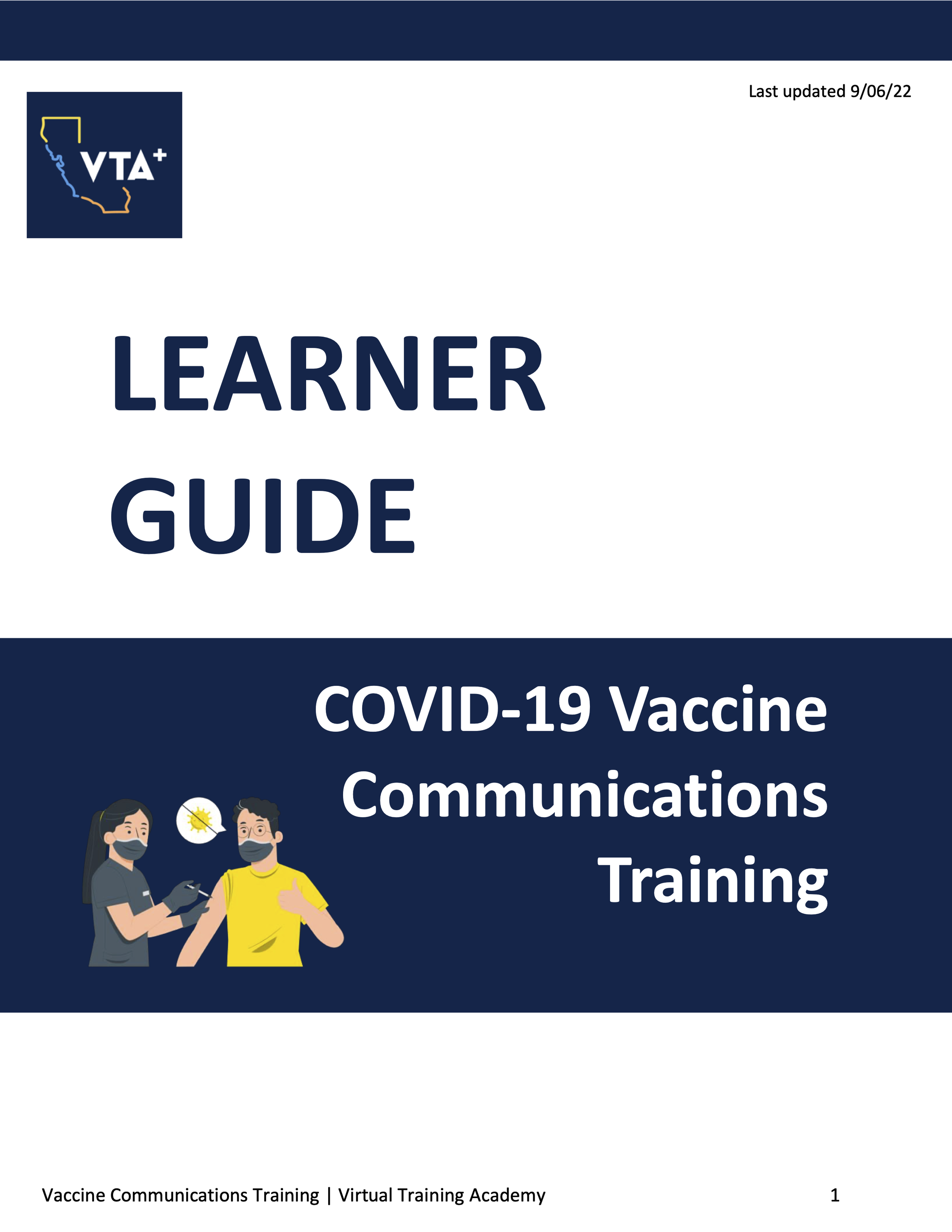
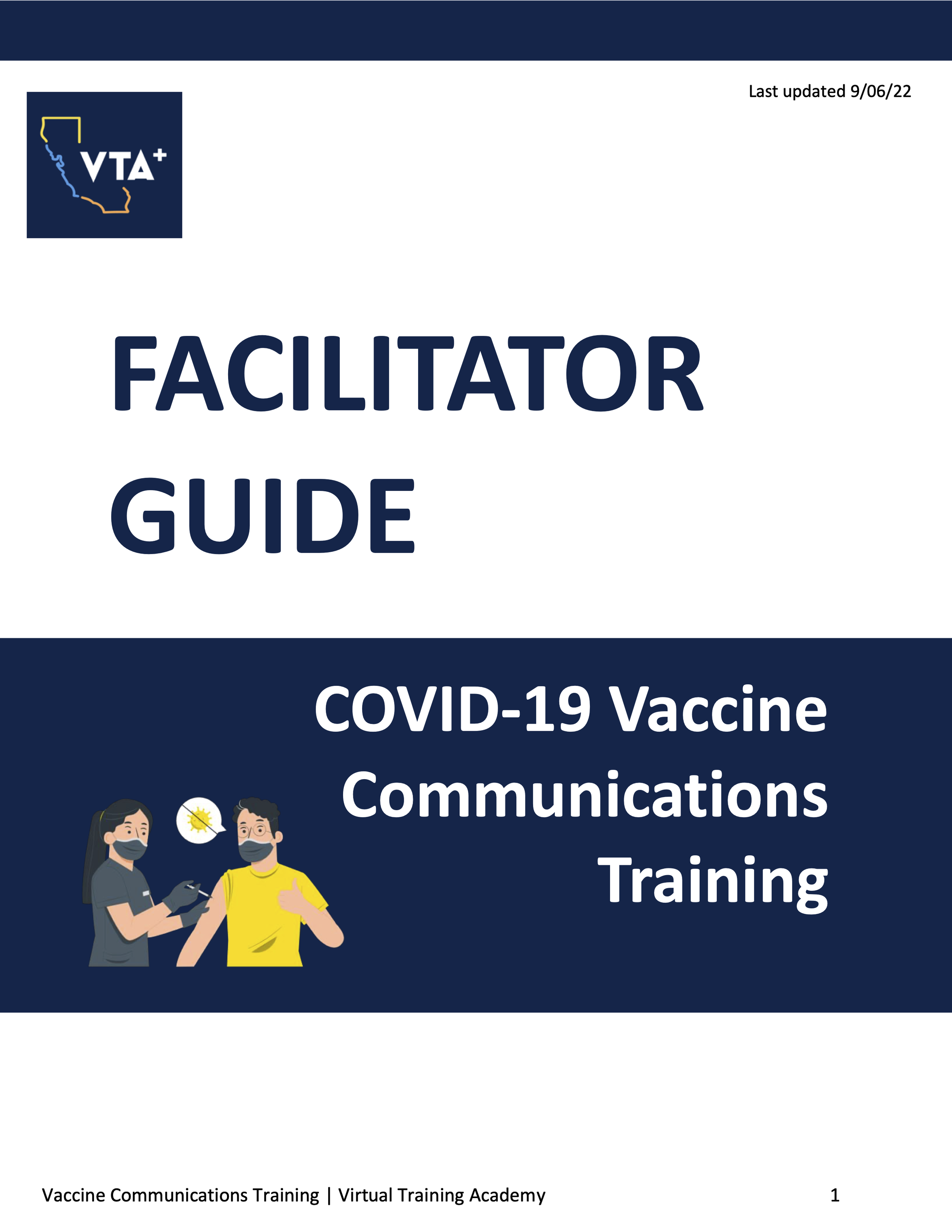
The live sessions were the practice layer of the blended design — where health coaching, interviewing skills, and cultural humility introduced in self-study were applied through structured role-play. These four documents show how that system was built and run consistently across 59 cohorts and 100+ facilitators. Live sessions were held via Zoom.
Outcomes and Publications
The VTA+ trained 13,336 unique learners across all 61 California local health jurisdictions, with 10,654 completions and over 22,900 total enrollments. The CICT course alone ran 59 cohorts and generated over 9,000 completions. Pre/post assessment data showed statistically significant knowledge gains (P<.001) — including among learners with no public health background, the population the course was designed for.
From the start, VTA+ courses were designed with evaluation built in — learning objectives and assessment instruments structured to measure knowledge gain and skill development, not just completion. That rigor generated three peer-reviewed publications in the American Journal of Public Health and Frontiers in Public Health, documenting the program's design, scale-up, and outcomes for the broader public health community.
Brickley et al. (2021). California's COVID-19 Virtual Training Academy: Rapid scale-up of a statewide contact tracing and case investigation workforce training program. Frontiers in Public Health. doi.org/10.3389/fpubh.2021.706697
Golston et al. (2021). Establishment and evaluation of a large contact-tracing and case investigation virtual training academy. American Journal of Public Health.doi.org/10.2105/AJPH.2021.306468
Harris, Taylor, Maher & Willard-Grace (2022). Health coaching across the stages of vaccine readiness and action: A practical guide for public health nurses.American Journal of Public Health. doi.org/10.2105/AJPH.2022.306774
Attribution
All content in this webpage is COPYRIGHT © 2021 CALIFORNIA VIRTUAL TRAINING ACADEMY.